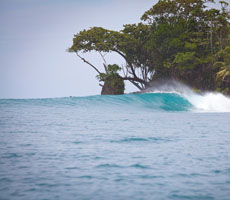

Matt Rohrer shares some of the highlights of his conversations with Bay Area surfer Jimmy Holt, focal point of one of the few surfing photos to ever appear in National Geographic Magazine. Selected photos: Jim Shaw

A sign on the 130-year-old pier at Saltburn-by-the-Sea warns people not to jump off it. On a big surf day surfers make their way to the end of the sturdy 206 metre structure and jump like lemmings into the cold, murky North Sea. Words: Simon Palmer Photos: Ian Forsyth

Chris Burkard's photographs are about more than barrels, perfect point breaks, and carving radical lines – they capture a moment in which the surfer is a mere player and the real star is the scenery. Words: Dan Hamlin Photos: Chris Burkard

Following the demise of Clark Foam, 'eco' boards and alternatives to petro-chemical products have been the focus of developments in surfboard technology. Words: Mark Sankey Photos: Alexa Poppe

Championed by surfers in the know for over 30 years, but largely ignored by mainstream riders; has the time finally come for the Bonzer to shine? Words: Steve Croft & Mark Sankey Photos: Alexa Poppe

Portugal explodes onto the global big wave circuit with a handful of household names and a freakish wave canyon. Photos: Jorge Leal and Wilson Ribeiro.


Test tube surf boards
July 04, 2009 | Words By:

pic-credit-robert-liu

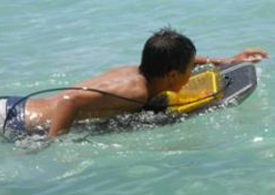
Eco-friendly scientists in Hawaii embed test tubes into their boards.

We all know that there’s nothing more frustrating then being stuck at work on a good wave day. An ingenious bunch of scientists in Honolulu have found a way of taking their work to the beach by embedding their test-tubes into their boards!

They fill up the test tube, paddle out, catch a few waves then catch a wave back in once the chemical reaction has finished.

The chemists at the University of Hawaii use the “surf reactor” to harness sunlight to create versions of the vitamin A molecule with unusual geometries. They say the ocean is perfect for harmlessly soaking up any excess heat made by the chemical reaction in the test tube.

Experiments like this usually need cool water pumped around them to keep them cool, so this “simple floating solar reactor” is the eco-friendly option.

The scientist who built the board says it would be easy to scale up the reaction by just using a bigger surfboard.

I’m impressed.

A few more pictures here (plus the paper if you can stomach it).


Comment


Advertise here