


The road to freedom
 Most of us shy away from philosophy. It’s irrelevant; too complex, too boring, too time-consuming. But did you know that ‘philosophy’ translates literally from Greek as ‘love of wisdom’? So if your idea of a good education is spending hours on Swaylocks researching displacement hulls, you can still safely consider yourself a philosopher. Or a philo-surfer. Geddit?
Surfing is a surprisingly good prism through which we can look at life. But why do we surf? And can the answer to that question help us to understand how we live our lives in general?
The most traditional way of understanding our place on earth was first struck upon by Aristotle, more than 2,000 years ago. He suggested that each of us has a predetermined ‘essential’ destiny to fulfil, and to not achieve that was to fail at life. Such a way of thinking seems to pervade surfing – what surfer hasn’t felt a sense of destiny, of belonging, the first time they slide down the face of a wave? The experience is something we long to inherit or pass on. In Hawai’i, giant olo boards were handed down through generations of watermen, and today, groms from surfing dynasties like the Currens or the Keaulanas apparently still feel the same irresistible pull towards the ocean. In the south of France I saw, carved into a lifeguard hut, a line paraphrasing Simone de Beauvoir, which I thought summed this up pretty well – “One does not become a waterman, but is born one”.
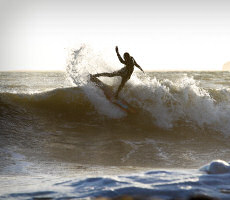
Which brings us to a school of thought that lies at the opposite end of the spectrum to Aristotle’s vision of destiny – existentialism. Here, we are free to make exactly what we want of life: it is a blank page waiting to be written. Existentialism is that ‘living in the moment’ sensation we feel when we surf. Once you’re in the water, that wondrous moment when you feel at one with the wave, when everything comes right and you’re swept up, pushed along, taking that first breath of cool, salty air as the spray licks your face and you spring to your feet, when the day’s cares vanish and your mind becomes a beautiful blank, totally tuned into the ocean – that’s existentialism. It’s the love of the present without recourse to the past or future. When I spoke to Andy Martin recently, he mentioned how the great existentialist Jean-Paul Sartre likened life to surfing in that, unlike skiing, it “leaves no trace”.
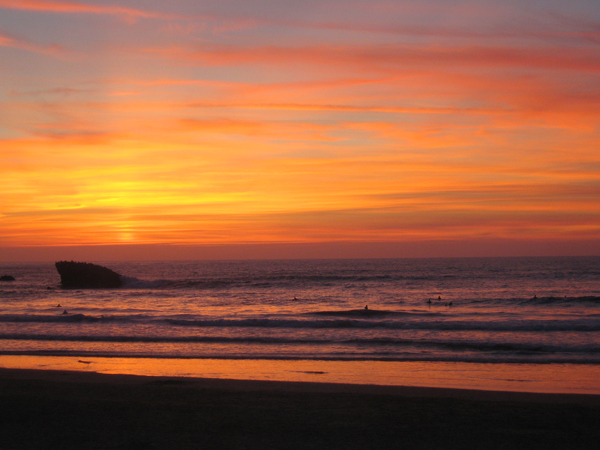 But all this freedom that existentialism supposedly offers us comes with a catch: we are “condemned to be free”, said Sartre. The more we surf, the more we need to surf. What starts as a tickle becomes an insatiable itch that must be scratched. And as the passion for that existential moment becomes overriding, we must eschew the destructive conformity of regular life in search of waves, or risk the spiritual death of living in “bad faith”. Not such an easy task for those unable or unwilling to shrug off the mundanity of education, family life and regular work.
So what is it to be, surfing and life as ‘essential’ or ‘existential’? Who knows, and frankly does it matter? Whether you feel you were always meant to be on a board, or you caught your first wave as the result of some happy accident, most surfers would agree that the sense of freedom they get from slipping across the ocean is what it’s all about. Sure, we might not actually be ‘free’ – but for those few moments, nothing else really matters. Some things simply defy categorisation.










Philosophy does not translate as “love of knowledge.” It is “love of wisdom.”
1Eduard Zeller gives earliest meaning of philosophy as “thirst for learning”(Outlines of the History of Greek Philosophy)
2noted and changed – thanks matthew.
3