

The search
 Let me take you back to early Spring 2002, if my memory serves me correctly… I had timed a day off work to coincide with a good swell, but when the day and the swell arrived, so did the inevitable wind screaming out of the southwest.
With the sky heavy with dark grey cloud, I headed over to Harlyn Bay in an effort to find shelter and ferret out some good waves. But an oversight on my part meant that when I arrived, it was a super high tide and the swell I had awaited simply unloaded onto the sand dunes in one long line, stretching across the beach.
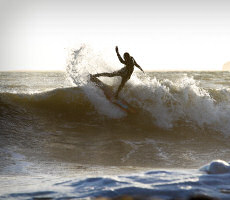
Then it struck me (even if there wasn’t much logic to it) – go to St Agnes. I hadn’t been out West for a while, so to the Badlands I headed. Pulling into Trevaunance Cove carpark, the first signs of surf looked good, and peering down from the vantage point I could see the wind and tide had receded and wedging right-handers were peeling across the bay. Due to it being midweek, midday, and outside of the holidays, it was uncrowded. What followed was a session more-than-worthy of a day off. When my last wave closed out, I rode prone towards the beach. Paddling out was none other than the evergreen Tom Curren.
I later learned that Tommy was here on a European promo tour for ‘Realm’, and that this day provided the best waves of the trip. I hung around and watched as Curren provided a masterclass in style, power and all-round mastery of surfing. He drew uncluttered lines all over the waves and dissected each section with manoeuvres performed with surgical precision. Video just doesn’t capture the moment like seeing it for yourself.
You could write several pages – at least – on Tom Curren’s influence on modern surfing, including his tutoring of a young Kelly Slater. But perhaps less is appreciated of his influence on post-modern surfboard design.
In 1993, Tom Curren reappeared at an ASP event in France after a hiatus from competition. With him he brought a 1969 5’4 Rick Twin Fin he had bought second-hand in New Jersey. Matt Hoy, then ranked eighth in the world, drew Curren in the second round, which was held in onshore slop. Curren destroyed Hoy with a combination of blazing speed and powerhouse tail slides on his fish. Curren then accidentally brings the fish back to the attention of the masses, by appearing in the Rip Curl Search film ‘Beyond The Boundaries’ riding various fish. Going on the fish hunt, he rides a Skip Frye fish at J-Bay and the infamous Tommy Peterson shaped 5’7 hybrid Fireball Fish (which had three fins) in giant Indo waves, all around 1994.
He also had a period in the early nineties experimenting with singlefin boards made with the same dimensions as standard thrusters, which he can be seen riding in ‘Litmus’. Incidentally, the back-to-front vee-to-concave bottom shape that Rich Pavel uses on his now famous Speed Dialler is a product of an experimental period Curren and Maurice Cole had in France. Cole was shaping Curren a gun, confused the pintail and the nose and shaped the bottom contours back-to-front, so the board ended up with a vee in the nose and concave in the tail rather than vice versa. Cole had it glassed up anyway, and Curren loved it; Pavel later adopted the design for his own experiments.
Also known for bodysurfing to avoid the crowds and cameras, making music and being reticent to the point of reclusiveness, Curren’s holistic approach to surfing takes in both function and feeling, so it’s no surprise that his eclectic approach kick-started a design revival.
(photo by Alexa Poppe)