


Of brands and boards
 Seen in the lager and chants of a pub on ‘Game Day’, or the picnic spread of Pimm’s, strawberries and cream during the weeks of Wimbledon, sometimes the culture of sports such as football and tennis can come to overshadow the practice of that sport itself.
So with surfing, beyond the waves, its name provokes impressions of the beach bum, with long hair and long shorts, a serene smile in the sun and a generally relaxed attitude to the world. In brighter colours and with less angst than the Skaterboi, the stereotype of the Surfer Dude is well depicted by Crush the Turtle in Finding Nemo. With drawn out ‘whooas’ and ‘duuude’ and ‘awessoome’ in mellow enthusiasm, there is no need for mention of board or break or swell for all to recognise ‘the surfer.’
![Billabong-Pro-Pipeline-Masters-2008---surfglassy[1]](https://driftsurfingmagazine.driftdigital.co.uk/wp-content/uploads/2013/12/Billabong-Pro-Pipeline-Masters-2008-surfglassy1.jpg)
© Surfglassy “Billabong Pro Pipeline Masters 2008”
Some rights reserved. Source: Flickr.com
This impression of the surfer as the loveable outlaw of society grew with the sport itself, from its conception in Australia and California in the 70s. Amongst these rogues were the founders of the big surfing brands we know today. It was in 1969 that Doug Warbrick and Brian Singer established Rip Curl in Victoria, and a few years later, on the Gold Coast Gordon Merchant began making boardshorts on his kitchen table, under the name ‘Billabong.’

© Mike Baird “surfer-morro-rock-1-12-07_3”
Some rights reserved. Source: Flickr.com
Reclaiming the surfer spirit
All three men were keen surfers themselves and their businesses were conceived with the practicalities and necessities of the sport in mind. These were gradually side-lined however as the culture of the surfer became more prolific in pop culture: baggy hoodies and BBQs and rebelling not by attacking society but by shrugging your shoulders at it. The big surfing brands branched out with extended clothing lines to catch this swell of interest and were soon selling more products for the beach than the sea. What some regarded as an almost spiritual sport, an honest connection with the sea, was lost under plastic shark tooth necklaces and Hawaiian shirts.
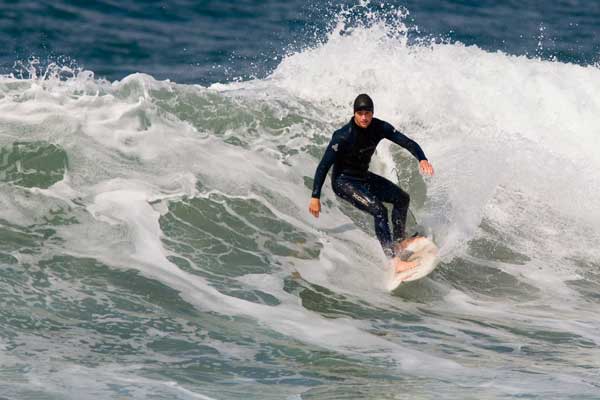
© Mike Baird “surfer-morro-rock_3”
Some rights reserved. Source: Flickr.com
In response to cries that they have lost their way, we now see brands such as Billabong and Rip Curl attempting to return to their roots. Billabong’s new line steers clear from the genericness it has been accused of in the past, trying to recapture the integrity that could be found at Warbrick’s kitchen table forty years ago. Rip Curl are following a similar tact by launching alongside their winter collection, the ‘Craft’ line, highlighting the authenticity of their clothes. With such moves the brands hope to reclaim their cool, and put the spirit of the waves back into their products; supporting the surfer, and neglecting the stereotype.